How to navigate this website customization. Please don’t delete this page! Update it if you find better practices that should be passed on to the next year’s organizers.
Last updated: 22nd January 2024 by Lídia del Rio.
- General rules of thumb
- Changing logos and page settings
- Lists of speakers and sponsors
- Lists of talks and posters
General rules of thumb
- Run from the Divi editor like the plague. Whenever it causes troubles, look for a button that says “return to regular editor“.
- Internally, you can use google sheets or similar to keep track of information that’s publicly available (like accepted talks, schedule, etc), but for private information (like registrations) I wouldn’t recommended it given data protection regulations; use local scripts or your university’s office-like packages.
- Update the privacy policy with (1) who the local organizers are (institutions), (2) what’s the sovereign data protection law that applies (usually your country’s).
- Update the code of conduct to include links to the host institution’s code of conduct.
- For design things (like the sponsors brochure, the conference poster and designing the badges) we used Canva. It’s great.
- Add/activate a cookies opt-out plugin if you use cookies!
- Processing fees and registrations: For TQC 2024, we used the WooCommerce plugin, with Stripe. Please contact Christian Schaffner and IAQI, as there may exist already a IAQI solution for this.
- Preparing the conference schedule will take at least 2 days, probably more. Don’t try to outsource it; a scientist needs to do this or else the conference might be chaotic, with people wanting to change rooms all the time. You can ask the PC to group talks by topic, but don’t leave the scheduling to the PC alone, as you need to ask speakers for restrictions (eg, many are unavailable on Monday or Friday). Here’s an example of how we did it for TQC 2024.
- Creating a Discord server is useful for people to ask questions to speakers, who can then ask during the whole week. It’s also very useful for people to coordinate travel, for quick announcements, and so on. Feel free to use an alternative to Discord (eg Mattermost can be hosted locally), if you can afford the time to configure it. It is however essential to have a way for people to interact that they can use from their phones.
- Be very generous with the information you display on the travel information page. Of particular importance are (1) how to get visas, (2) hotels and discount codes, (3) where to print posters. See this example.
- After the conference, create a 1-page archive version of the website, similarly to eg TQC 2024, which should include the list of talks and posters (see below). You can create another page for the photo gallery, if you’d like.
- After the conference, export a local file with all private information (eg registration data, contact forms with sensitive data), and delete it from the website.
Changing logos and page settings
Sidebar
What: Sidebar on the right of the page, with how to contact us, sponsors, and quick information.
How: On the black WordPress sidebar on the left, go to, Appearance > Customize > Widgets > Sidebar
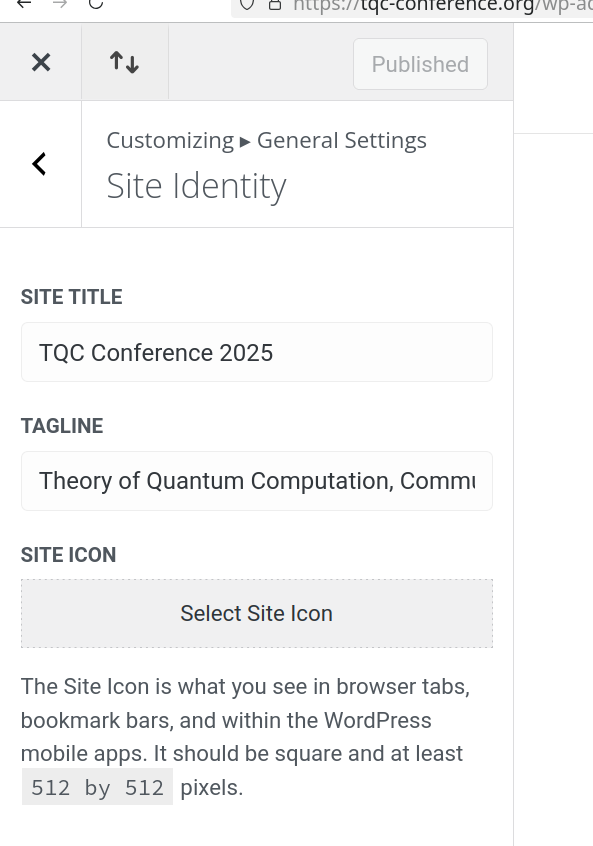
Site icon
What: Little square icon that appears on the list of tabs.
How: On the black sidebar, Appearance > Customize > General settings > Site identity > Site Icon

Website logo
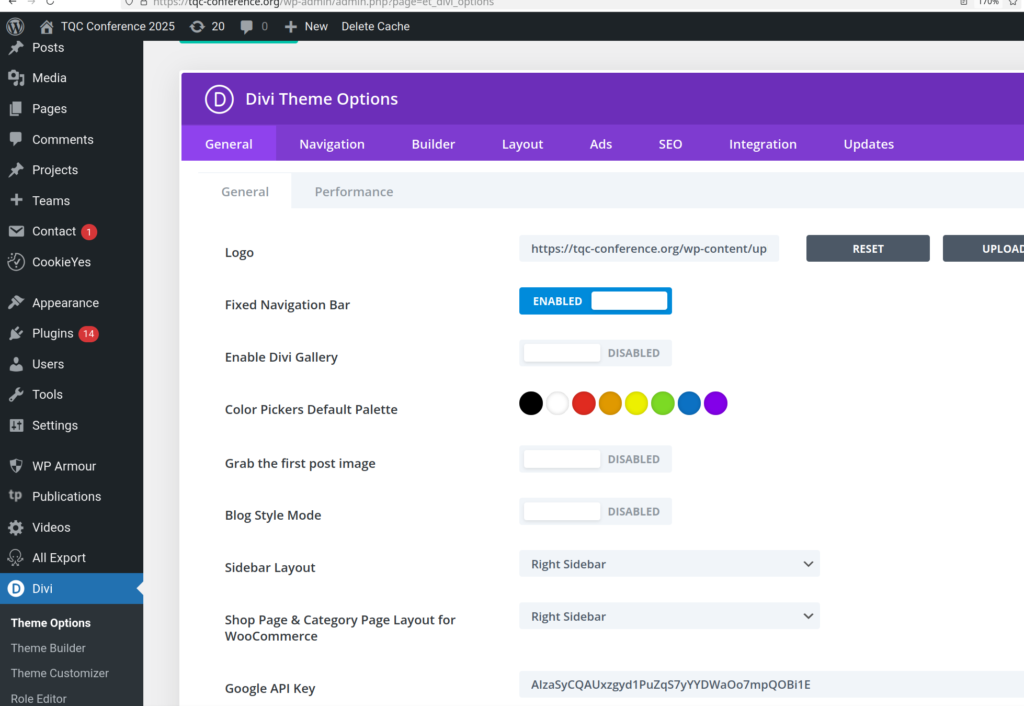
What: Rectangular logo that appears on the nav bar (top left, near the menu, usually says TQC 20xx and has a little picture)
How: On the black sidebar, Divi > Theme Options > General > Logo

Lists of speakers and sponsors
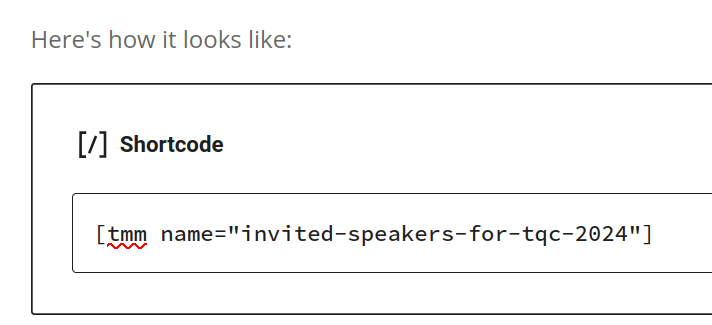
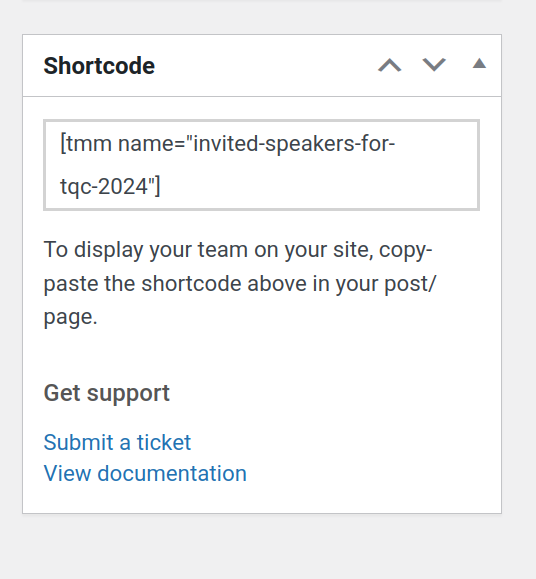
We’ve used the plug in Team Members to do this. For each edition of TQC we create a team called “invited speakers TQC 20xx”, another called “platinum sponsors TQC 20xx” and so on. Then on the page where you want to display it, you simply need to paste the shortcode.
Creating a team
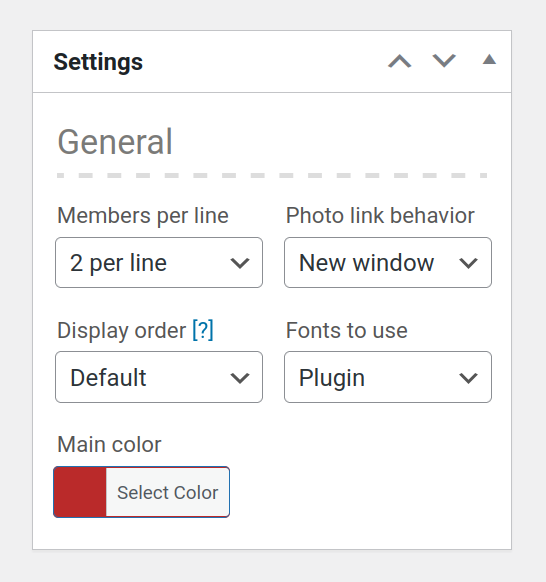
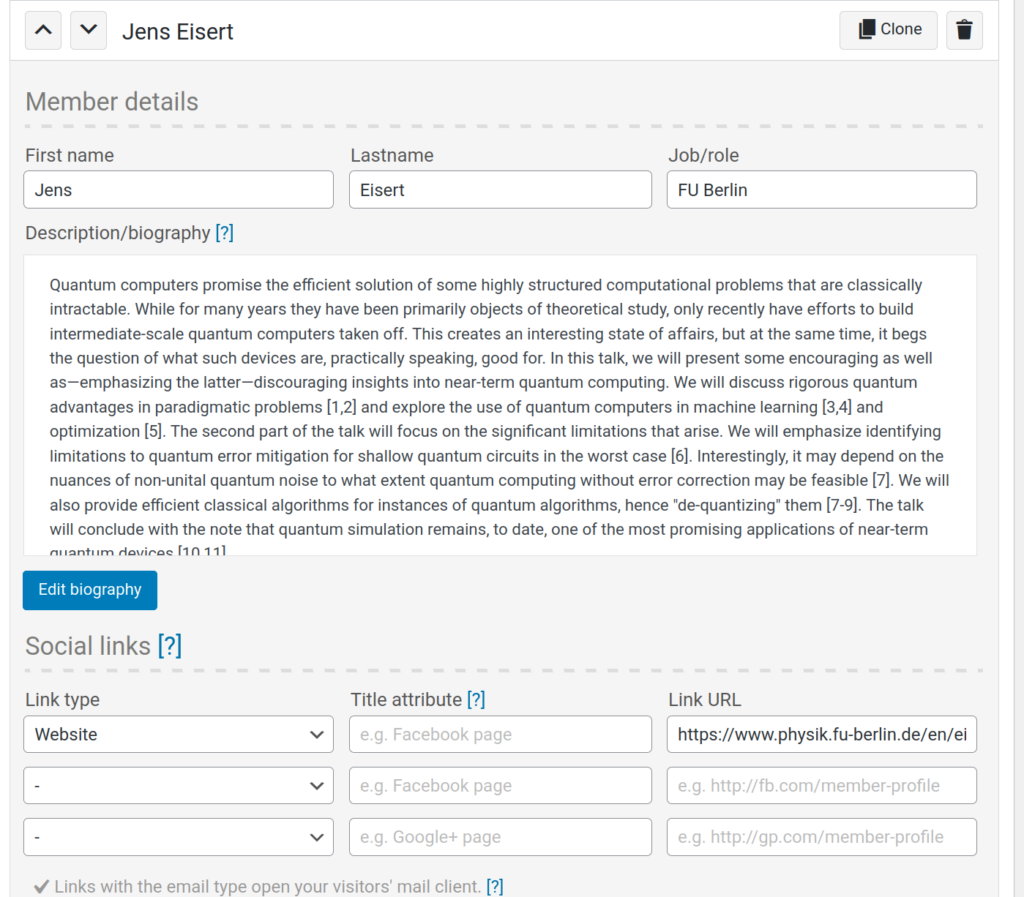
On the black sidebar, Teams > Add a new team. When in doubt, look at one of the older teams for the settings. Here are some.
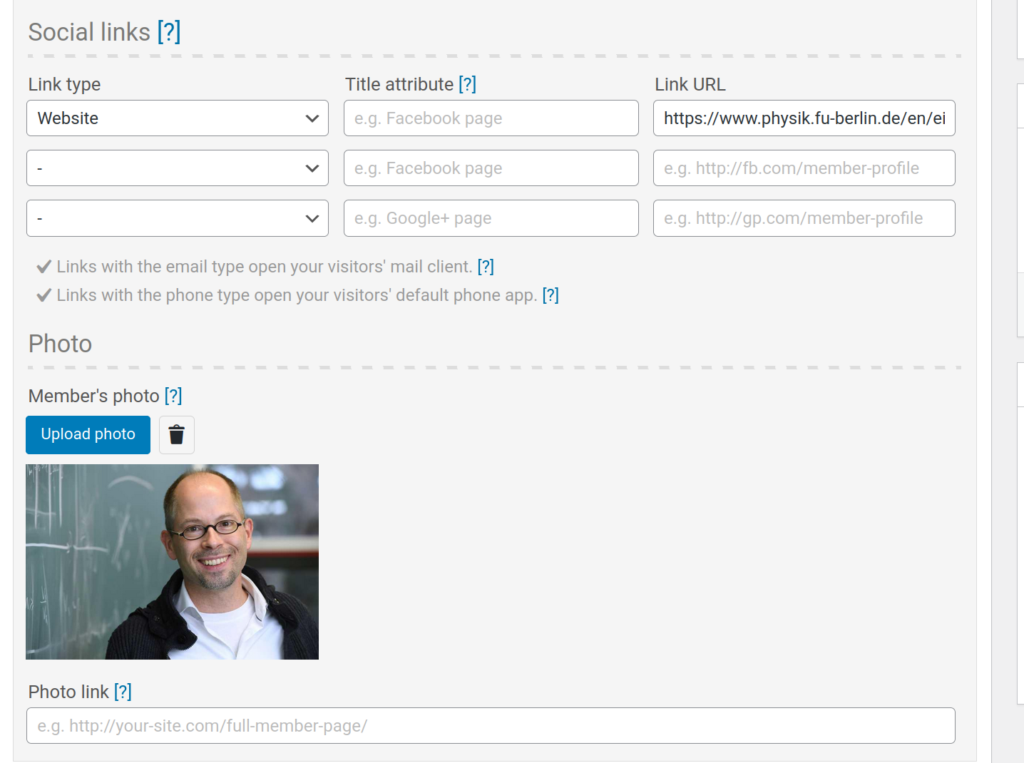
- 2 members per line; photo link behaviour: new window; different colours for different teams (eg for gold, silver, platinum sponsors).
- Use field Description/biography to put the title and abstract (for invited speakers) or the blurb paragraph (for sponsors).
- Use field Job/Role for the affiliation (for speakers)
Displaying a team
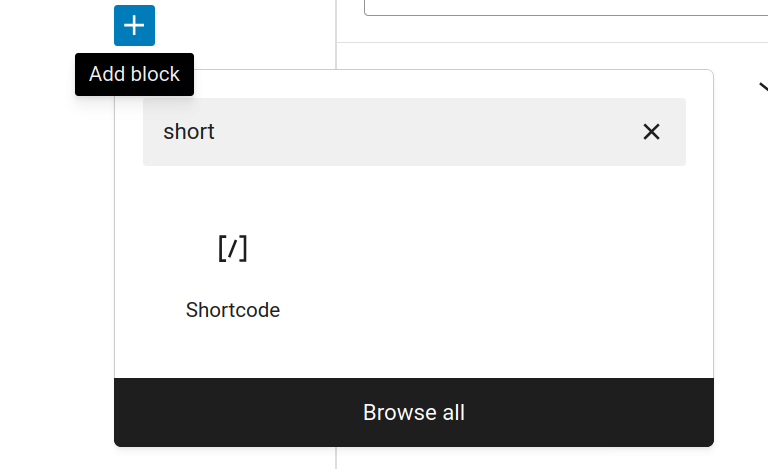
On the page where you want to display a team, add a block of shortcode and write paste the shortcode found on the TEam settings.
Here’s how it looks like:
Potential and Limitations of Near-Term Quantum Computing
Quantum computers promise the efficient solution of some highly structured computational problems that are classically intractable. While for many years they have been primarily objects of theoretical study, only recently have efforts to build intermediate-scale quantum computers taken off. This creates an interesting state of affairs, but at the same time, it begs the question of what such devices are, practically speaking, good for. In this talk, we will present some encouraging as well as—emphasizing the latter—discouraging insights into near-term quantum computing. We will discuss rigorous quantum advantages in paradigmatic problems [1,2] and explore the use of quantum computers in machine learning [3,4] and optimization [5]. The second part of the talk will focus on the significant limitations that arise. We will emphasize identifying limitations to quantum error mitigation for shallow quantum circuits in the worst case [6]. Interestingly, it may depend on the nuances of non-unital quantum noise to what extent quantum computing without error correction may be feasible [7]. We will also provide efficient classical algorithms for instances of quantum algorithms, hence "de-quantizing" them [7-9]. The talk will conclude with the note that quantum simulation remains, to date, one of the most promising applications of near-term quantum devices [10,11].
[1] Rev. Mod. Phys. 95, 035001 (2023).
[2] arXiv:2307.14424, Nature Comm. (2024).
[3] Nature Comm. 15, 434 (2024).
[4] Nature Comm. 15, 2277 (2024).
[5] Science Adv. 10, eadj5170 (2024).
[6] arXiv:2210.11505, Nature Phys. (2024).
[7] arXiv:2403.13927 (2024).
[8] arXiv:2309.11647 (2023).
[9] Phys. Rev. Lett. 131, 100803 (2023).
[10] Nature Comm. 14, 3895 (2023).
[11] arXiv:2108.08319, Nature Comm. (2024).

Forward and Backward Mappings for Quantum Graphical Models
Graphical models offer a unifying framework for various statistical learning algorithms and models. Central to these models are the forward and backward mapping problems, which have been studied through both exact and approximate algorithms. This talk explores these mapping problems within the context of quantum graphical models, where quantum states generalize classical probability distributions.
The forward mapping problem involves deriving mean parameters from model parameters and is closely linked to approximating the partition function---a typically challenging task often requiring heuristics and approximations. We'll discuss quantum belief propagation, which has shown success in one-dimensional systems, as well as variational methods such as Markov entropy decomposition that tackle the problem from an optimization perspective.
The task of the backward mapping problem aims to compute model parameters from mean parameters. It is related to the Hamiltonian learning problem, a topic of growing interest in quantum information science lately. We'll review some existing algorithms and introduce the quantum iterative scaling (QIS) algorithm that reduces the backward mapping problem to a series of forward mapping problems. We'll present a convergence proof for QIS and demonstrate its advantages over gradient descent methods. Furthermore, we'll explore how quasi-Newton methods can enhance QIS and gradient descent algorithms, showcasing significant efficiency improvements.
Understanding Cryptographic Hardness in a Quantum World
A flurry of exciting, recent work has shown that the mathematical hardness required to realize cryptosystems such as bit commitments and secure computation in a quantum world can be significantly weaker than the hardness required for classical cryptography. This talk will discuss recent progress and some remaining challenges in understanding the assumptions that enable cryptography in a quantum world.
Quantum cryptography without one-way functions
The existence of one-way functions is the minimum assumption in classical cryptography. On the other hand, in quantum cryptography where quantum computing and quantum communications are possible, recent studies have demonstrated that the existence of one-way functions is not necessarily the minimum assumption.
Several new fundamental primitives have been introduced, such as pseudorandom unitaries, pseudorandom states, one-way state generators, EFI pairs, and one-way puzzles. They seem to be weaker than one-way functions, but still imply many useful applications, such as secret-key encryption, message authentication codes, digital signatures, private-key quantum money, commitments, and multiparty computations, etc. In this talk, I explain the basics of this “quantum cryptography without one-way functions” and give many open problems that I want to know the answers to.
Lists of talks and posters
We used the plug-in TeachPress for TQC 2023 and 2024, which worked okish given the way that EasyChair exported data. However, I believe that Christian Schaffner has a smoother plug-in for this; please contact him! If you create more efficient code, please make it publicly available to next year’s organizers.
What we did:
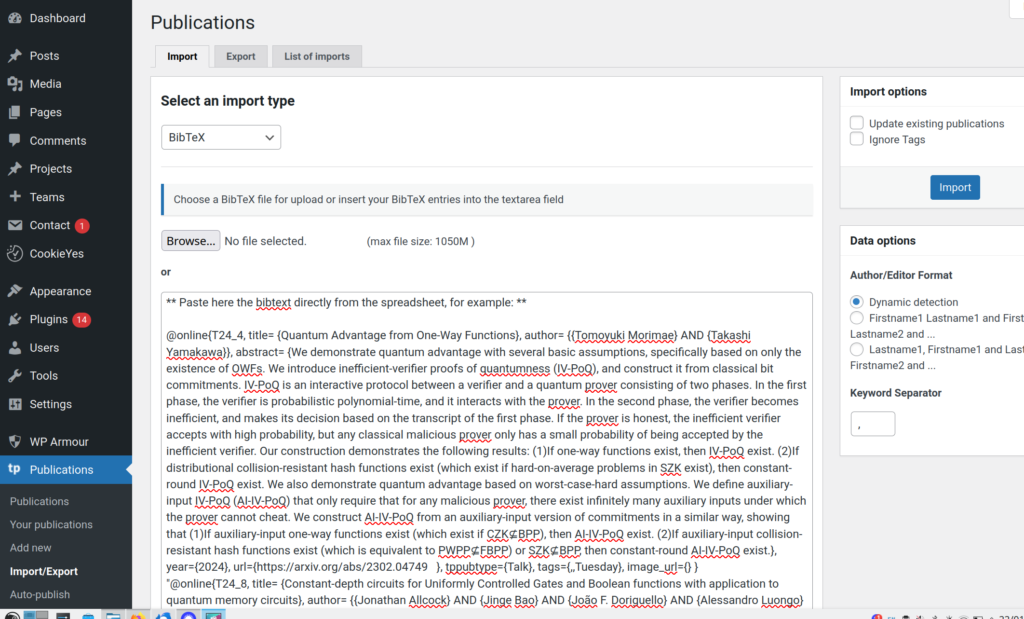
- Use a spreadsheet or code of your choice to generate the a column that looks like bib, including tags and types of contribution like “poster”, “invited talk”, “Session A”, “proceedings”. See this example : column U is the bibtex.
Notes: The date/year should be the year of the conference! The selection of what goes into tags, type, etc on the spreadsheet is based on a lot of trial and error; feel free to copy it if it’s useful. The thumbnail links come from a contact form when we asked speakers to send us a picture. - Select all the bibtex (all of column U in the example) and paste it in the import form of Teachpress. To do this, on the black sidebar, Publications > Import/Export. See picture below. Toggle the “update existing publications” box if you’re adjusting publications. This usually works smoothly.
- To display, add a shortcode to the page where you want it, and you can filter by type (eg just talks or just posters), add a search field, highlight tags, and so on. See for example the code on the accepted talks for TQC 2024.
- Documentation for the plug-in here, including how to customize what is displayed.